
The June 2 elections in California and San Francisco will make a national statement, and demonstrate whether voters are ready to push back, in a serious way, against the terrible damage of the Trump Administration. Are voters ready to acknowledge that economic inequality is an existential crisis, and support candidates and ballot measures devoted to taxing the rich? Can we elect candidates who believe that housing is a human right, not a speculative good to be sold for profit? Will San Franciscans allow a very rich mayor who is allied with billionaires and their agenda to continue to dominate local politics without effective opposition?
Will all the energy that we’ve seen at the No Kings marches translate at the polls?
This is a critical time for all of us. Please: Cast your ballot in the June election. It’s easy (see page 11). Our endorsements follow.
Governor
Tom Steyer
What a godawful mess.
The race to replace termed out Gov. Gavin Newsom has become a prime example of everything wrong with the Democratic Party in California. The former front-runner is a serial sexual harasser and possibly rapist who kept getting elected to Congress because nobody in his own party called him out. Every single candidate still in the race is a YIMBY; every one of them argues that the private market, if deregulated, will produce more affordable housing. There is no Zohran Mamdani in California politics, no Bernie Sanders, no AOC. The two leading progressives, Betty Yee and Tony Thurmond, were able to raise little money and get little traction. Newsom, who cares about nothing except his presidential ambitions, has shown no leadership at all, creating a situation where it’s possible that two Republicans will emerge on top of the primary, leaving no Democrat in the November race.
So now we are faced with supporting the best candidate in the race, a billionaire who made a fortune investing in, among other things, fossil fuels and private prisons.
Electing a billionaire who has no experience running anything remotely the size and complexity of a big city or state has not worked out well in San Francisco.
But Steyer has a lot going for him, including the support of many labor unions and Sanders’ national group, Our Revolution. He has no record in office, but a long record (once he got out of the hedge fund business) of putting money and effort into serious efforts to take on climate change. He is the only major candidate talking seriously about economic inequality and taxing the rich. Those two issues form the basis of the existential threats facing humanity, and it’s encouraging to see a candidate for governor who recognizes that.
He says he wants to reform Prop. 13 by eliminating the loophole that lets big investors like Donald Trump cheat local governments out of critical revenue. He also says he supports single-payer health care in California (although Newsom said the same thing when he was running and abandoned that promise the day he took office).
None of the other major candidates are even talking about these issues.
Besides, PG&E is spending $10 million to defeat him. We can’t think of a better reason to support a candidate.
So, with all of our usual caveats (rich people can promise whatever they want, and Newsom’s betrayal on health care is a case in point), the best of the candidates is Steyer, and he has our support.
Secretary of State
Shirley Weber
At a time when Donald Trump and his allies want to destroy democracy by making it difficult or impossible for millions of Americans to vote, it’s critical to have a state elections officer willing to fight back. Weber, appointed to the post by Gov. Gavin Newsom, has been a strong advocate for voting rights, and we are happy to endorse her for a full term.
Insurance Commissioner
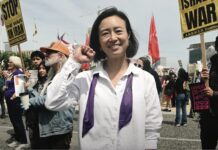
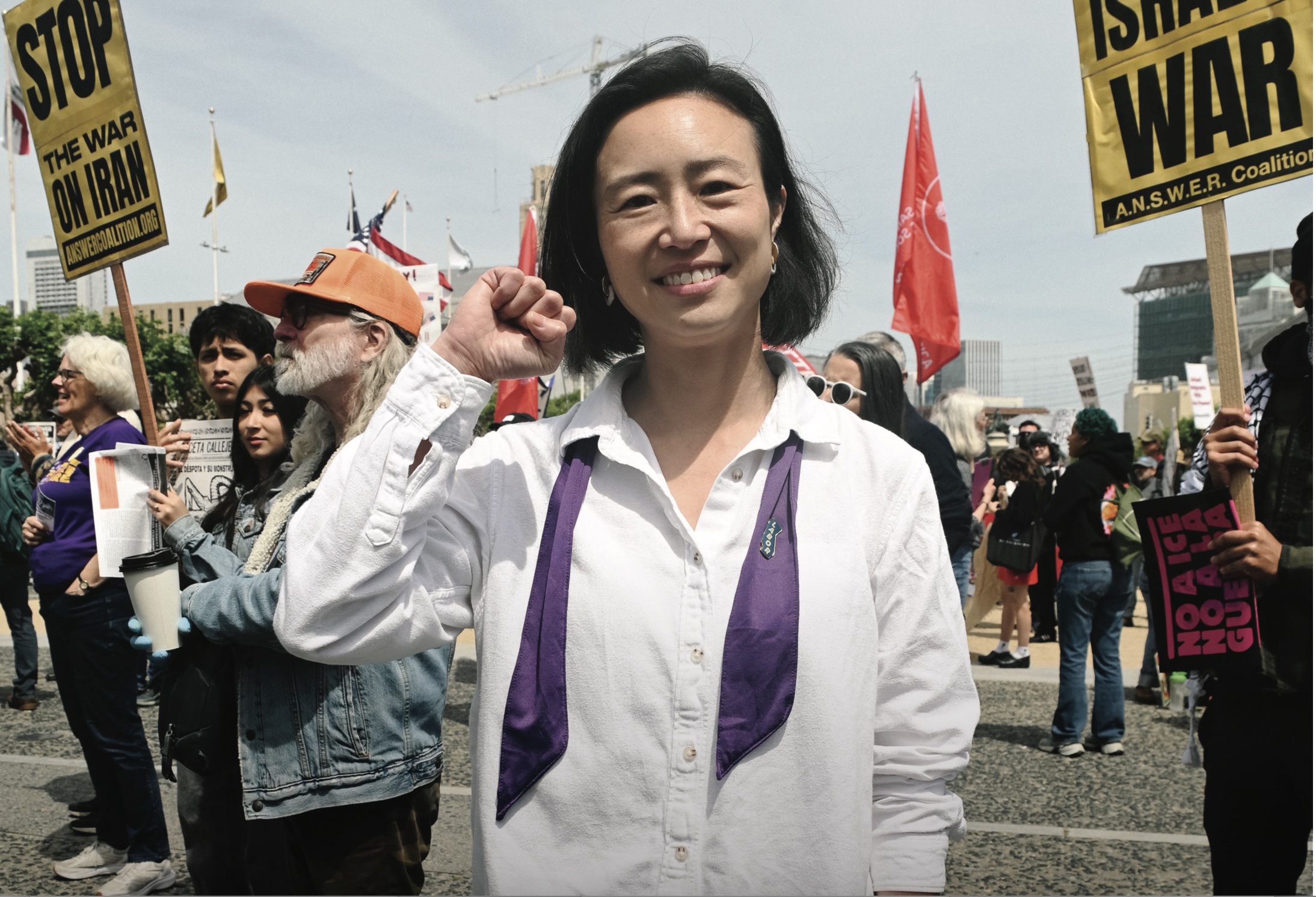
Jane Kim
The office of the Insurance Commissioner has in the past been a decent advocate for consumers; when John Garamendi had the job, he actually held some insurers to account and helped people fight for benefits. Not so under incumbent Ricardo Lara. The insurance industry in this state is out of control, denying or delaying claims in catastrophic fires, raising rates for car insurance, threatening to leave the state … and Lara has done little to nothing about it.
Jane Kim, former SF supervisor and director at the Working Families Party, is running a grassroots campaign to try to change that. She’s talking about a public option for car insurance, disaster insurance for everyone, and mandatory deadlines on claims. Nobody else in the race is offering that consumer-based approach. We’re backing Kim.
Board of Equalization, District 2
Sally Lieber
A lot of Sacramento insiders and policy types want to get rid of this board, and there’s no question it’s been a placeholder for marginally qualified people who want to get to statewide office. But we’re not sure it should be abolished: The board has, in the past, with members like the late Bill Bennett, been a check on private utilities like PG&E and an oversight board for local assessors. It’s not a huge expense, and could play a role in creating a statewide public-power system. Sally Lieber sees the benefits in the agency, and as a candidate with a working-class background, she fits the role. We’re happy to back her.
Congress, District 11
Connie Chan
The race to replace Rep. Nancy Pelosi in Congress is a rare, and critical, political event in San Francisco. The next member of Congress will likely be there for decades and have a huge influence not just on national policy but on local politics.
Pelosi decided early in her career that she wanted to move into leadership, and her constituency quickly became the national Democratic Party, not the voters of San Francisco. She became the first woman speaker, helped build Democratic majorities, and largely stayed out of San Francisco issues.
She also privatized the Presidio, leaving what should have been part of the National Park Service vulnerable to Trump’s attack.
We are looking for a representative who will take progressive stands in Congress, who will work for taxes on the rich, reductions in military spending, money for social housing, basic civil rights for all, including immigrants and trans people, and so much more. The Democrats may win a majority this fall, and Trump will be gone two years later; there’s a huge agenda to repair the damage he has done and rebuild a country nearly destroyed by economic inequality.
We also want a member of Congress who will help build, expand, and promote progressive politics back here at home, someone who will endorse, support, and raise money for candidates and ballot measures that advance the progressive agenda.
Three serious candidates are in the race. Our clear choice is Connie Chan.
State Sen. Scott Wiener, who has the citywide name recognition and huge amounts of money from Big Tech and Real Estate, likes to talk about how he would be a San Francisco liberal in Congress, and on a lot of social issues, he would be fine. But on economic issues, he represents the dangerous, losing, and ineffective side of the Democratic Party, the neoliberals who argue that free market solutions can address things like housing affordability and that taxing the rich is too hard and too divisive.
As a supervisor, he sided with landlords over tenants. As a state legislator, he has been the champion and darling of the YIMBYs, pushing legislation that deregulates housing and gives private for-profit developers huge breaks. He has ignored all the evidence that the free market won’t solve this problem, and has given big breaks to developers by eliminating affordable housing requirements for luxury projects. He’s also freely and actively used his influence to elect corporate Democrats to local office.
That’s not a good sign for our next member of Congress.
Saikat Chakrabarti talks about all the right things. He made millions in tech, as did plenty of others, but now argues that rich people like him should pay more taxes. He was an early supporter of AOC and her first chief of staff. He also worked for Sen. Bernie Sanders. All good reasons to support him.
But he also spent thousands of dollars helping the corporate Democrats take over the local party, and his money helped neoliberal Bilal Mahmood defeat the city’s only democratic socialist supervisor, Dean Preston. When we and others have asked about that, he talks about his friendship with Mahmood, and at points called him a “progressive.” That demonstrates a fundamental lack of understanding of how local politics works in San Francisco.
In every ad and every statement, he makes, he hypes his connections to AOC and Sanders. Neither of them has endorsed him. That says something. So does the fact that not one legitimate local progressive organization has endorsed him.
We appreciate Chakrabarti’s national agenda, but we want a member of Congress who will work to build the progressive movement in San Francisco, and his record suggests he’s not that person. In fact, he has supported candidates who have sought to undermine the progressive movement.
Sup. Connie Chan has a long record in San Francisco. In the past few years, as the chair of the Budget and Appropriations Committee, Chan has almost single handedly protected services for tens of thousands of people. She is by far the most pro-labor member of the board, and one of the most pro-labor politicians in San Francisco.
She’s also a Chinese immigrant—and electing her in the Trump Era would send a strong message that San Francisco will not support attacks on the immigrant community.
Chan has a strong progressive track record in public office. Wiener has a record of favoring landlords and Big Tech. Chakrabarti has no record in office.
We are happy to endorse Connie Chan for Congress.
(Full disclosure: Tim Redmond, who is the editor of the Bay Guardian, has an independent adult daughter who works for Chan’s campaign.)
Board of Supervisors, District 2
Lori Brooke
This is one of the most conservative districts in San Francisco, electing supervisors like Gavin Newsom and Catherine Stefani, who both moved on to higher office. The incumbent, Stephen Sherrill, was appointed by former Mayor London Breed after Stefani moved to the state Assembly. He had no credible local political experience at the time, but was close to Michael Bloomberg, who was also close to Breed. He has been a terrible supervisor, holding down the right flank of the board while whining about development at the Marina Safeway, which is possible only because the Breed-Sherrill ally, state Sen. Scott Wiener, undercut local land use controls.
We will be honest and direct: District Two is not going to elect a progressive supervisor. But Lori Brooke is the best we will likely get.
Brooke is never going to vote with progressives on cuts to the police budget, or on most tax measures. But unlike Sherrill, she is a legitimate, longtime neighborhood activist and leader who opposed the mayor’s Rich Family Zoning Plan. We’re supporting her.
Board of Supervisors District 4
1. Natalie Gee
2. David Lee
3. (Gasp) Albert Chow
Incumbent Alan Wong, appointed by Mayor Lurie, was a decent member of the Community College Board, mostly aligned with labor—until suddenly he wasn’t. From a progressive start years ago, he has moved rapidly to the right, supporting the mayor’s Rich Family Zoning Plan and Lurie’s efforts to push homelessness and substance use issues into the criminal justice system.
He has become a loyal Lurie ally, and the board desperately needs more independent voices who are willing to stand up to the mayor.
Four candidates are challenging Wong, and they are generally, if not formally, working together on a ranked-choice voting strategy that could oust a Lurie ally and move a step toward a more independent board.
We endorse that strategy.
Natalie Gee is by far the best candidate in the race. She’s been Sup. Shamann Walton’s chief of staff, and knows both public policy and City Hall politics far better than any of the other candidates, including Wong. She is a progressive in a district that ousted a progressive (Gordon Mar) in favor of a conservative (Joel Engardio)—but the same district then voted to recall Engardio. Gee listens to what the district wants, but is not afraid to say that Housing First matters, that turning the police on unhoused people is not the best solution, and that market-rate housing won’t solve the city’s affordability crisis.
She would be an exceptional addition to the independent bloc on the board, and we happily endorse her.
But this is an RCV race, and it makes no sense to ignore other independent candidates whose second-place votes could elect Gee.
David Lee has run for office with little success in the past. He started the Chinese American Voter Education Project, and frankly, has been all over the political map in past years. But he’s talking, daily, repeatedly, about the need to municipalize PG&E, and agreed at a recent forum that the city should immediately start the process of eminent domain.
Albert Chow is a hardware store owner and one of the leaders in the Recall Joel Engardio. Chow is the most conservative candidate; he is dubious about most taxes, including Prop. D, and is wary of taking over PG&E’s system. But he is absolutely independent of the mayor and the Lurie cronies; in fact, he said at a recent debate that the Grow SF crowd had offered him a commission appointment if he would drop out of the race, and he refused. So in the spirit of an RCV strategy to replace Wong, we are willing to give him a reluctant nod.
School Board
Brandee Marckmann
This seat is on the ballot because Phil Kim, a mayoral appointee, has not yet faced the voters. Kim is a former Charter School executive, which should disqualify him immediately.
Two credible challengers are facing him, Virginia Cheung and Brandee Marckman. Cheung has experience as a pre-school teacher and director of Wu Yee Children’s services, and has the endorsements of the League of Pissed Off Voters and the Bernal Heights Democratic Club. Our choice is Marckmann, director of the San Francisco Education Alliance, a grassroots group that calls for schools that “are fully funded, inclusive, and not privatized.” That’s exactly what the School Board, which is facing a strong push for more charter schools, needs right now. She has our support.
Superior Court Judge
Alexandra Pray
Two qualified candidates are running for a rare open seat on the local Superior Court. Most judges who are ready to retire leave in the middle of their terms, allowing the governor to replace them. But every once in a while, a judge does the right thing, retires at the end of a term, and allows the voter to choose a replacement. That’s what Judge Bruce Chan has done.
Both contenders are experienced trial lawyers. Both insist they will be fair. Neither can say much, because that’s how the rules work, although we think candidates for judge should be a lot more open on a lot of issues, including court administration: The sitting judges meet to elect a presiding judge and set operating rules, but those meeting are secret, closed to the press and public, and a candidate could easily promise more transparency without violating any judicial ethics. They could talk about cameras in the courtrooms, the right to record and photograph trials, and a lot more. But they don’t.
All that said, the two candidates could not be more different, and our endorsement could not be more simple and clear.
Phoebe Maffei is a prosecutor who works with a district attorney who has prioritized low-level, often silly and damaging charges in an effort to seem “tough on crime.” Under Brooke Jenkins, the courts are overcrowded, the jails are overcrowded (and dangerous), and the Public Defender’s Office has to refuse cases because there’s not enough staff and time to handle all the cases that should never have been filed or taken to trial.
Alexandra Pray is a public defender who has seen the impacts of this failed policy, and understands what it’s like to be charged with a crime that is either driven by mental health or substance use issues (or, of course, poverty) and be facing jail time when far better alternatives are or should be available.
Far too few lawyers who work on the defense side of the criminal justice system wind up on the bench. Most governors appoint either corporate lawyers (who may have donated money to their campaigns or have other political connections) or prosecutors.
No contest here: We are with the public defender. Vote for Alexandra Pray.
Ballot propositions
Proposition A
Earthquake Safety and Emergency Response bonds
YES
There are issues with this $535 million bond. It’s sold as earthquake safety, but includes $200 million to rebuild the Potrero Bus Yard, which is a valid project but only marginally related to earthquake safety. The city badly needs an upgrade to the emergency water system on the West Side of town, which this promises, but previous bonds promising the same thing passed, and the system still isn’t functioning properly. And yet, we rarely oppose infrastructure bonds, and this one, on balance, is worth supporting. Vote yes.
Proposition B
Term limits for mayor and supervisors
NO, NO, NO
This is a ridiculous solution in search of a problem. Prop. B would impose a lifetime ban on the mayor or supervisors serving more than two terms.
This, frankly, has not been a problem: Only once since the return of district elections has a supervisor served more than two terms, and that was Aaron Peskin—who was a good supervisor his first eight years, and a better supervisor when, after a break, he returned to office. No mayor has ever sought more than two terms.
The proponents claim this will “make room for a new generation” to lead at City Hall. Nonsense: New, younger supervisors have always won under district elections (sometimes for better, sometimes for worse).
Term limits for executives make sense; term limits for legislators are almost always a bad idea. Term limits have given lobbyists and special interests more control over the state Legislature. Experience matters in politics. To make things more ridiculous, the lifetime two-term limit would apply only to the mayor and the supes, not any of the city’s other elected officials.
More important, this takes control away from the voters. Under district elections, incumbency is not that powerful; two incumbents, Gordon Mar and Dean Preston, were defeated in the past two elections. Telling the voters in, say, D3, that they had no right to send Peskin back to City Hall would be unfair.
Under the ranked-choice district system, we already have term limits: They’re called elections,
Vote no on B.
Proposition C
Decreases to business taxes
NO, NO, NO
Prop. C exists only because billionaires Chris Larsen and Michael Moritz (who owns the SF Standard) and the Chamber of Commerce want to undermine Prop. D, which would raise taxes on the biggest companies with overpaid executives to help close the city’s budget deficit. The measure claims to exempt small businesses from that tax, but that’s a scam: No business with less than $1 billion revenue and fewer than 1000 employees would be taxed under Prop. D.
This is part of a larger, statewide agenda to use misleading ballot measures to undermine efforts to tax the rich. Vote no.
Proposition D
Overpaid executive tax
YES, YES, YES
This one should be obvious: Donald Trump’s brutal cuts to things like healthcare have deeply damaged San Francisco’s budget. The biggest corporations and most grossly overpaid CEOs have saved billions because of the Trump tax reductions. San Francisco voters have a chance to take a little of that money back with Prop. D.
The measure would increase gross-receipts taxes on corporations with more than $1 billion in revenue and more than 1000 employees if the CEO makes more than 100 times as much as the median employee. It would bring some $300 million into the city’s coffers—not as much as Trump has taken, but a step in the right direction. That money could stave off some of the worse budget pain; it’s almost enough to cover the projected deficit.
Opponents say it will drive businesses out of town and undermine the city’s recovery, but that’s a lie and they know it. Doordash isn’t going to stop doing business in San Francisco because of a modest tax increase. Neither is Uber, Amazon, or Visa. PG&E has already moved its headquarters out of the city—and unless it wants to give up and sell the local grid to a municipal utility, it can’t stop doing business here. Same for the other giant corporations that would pay this tax.
If Uber or Amazon suddenly abandoned San Francisco, that would be a huge benefit to real cab drivers and small local merchants. But it won’t happen.
San Francisco’s recovery depends on its ability to provide essential services, not just on pandering to giant corporations. Layoffs of city workers create just as much economic damage as Big Tech layoffs. Don’t buy the lies and the hype, paid for entirely by billionaires. Vote Yes on D.