

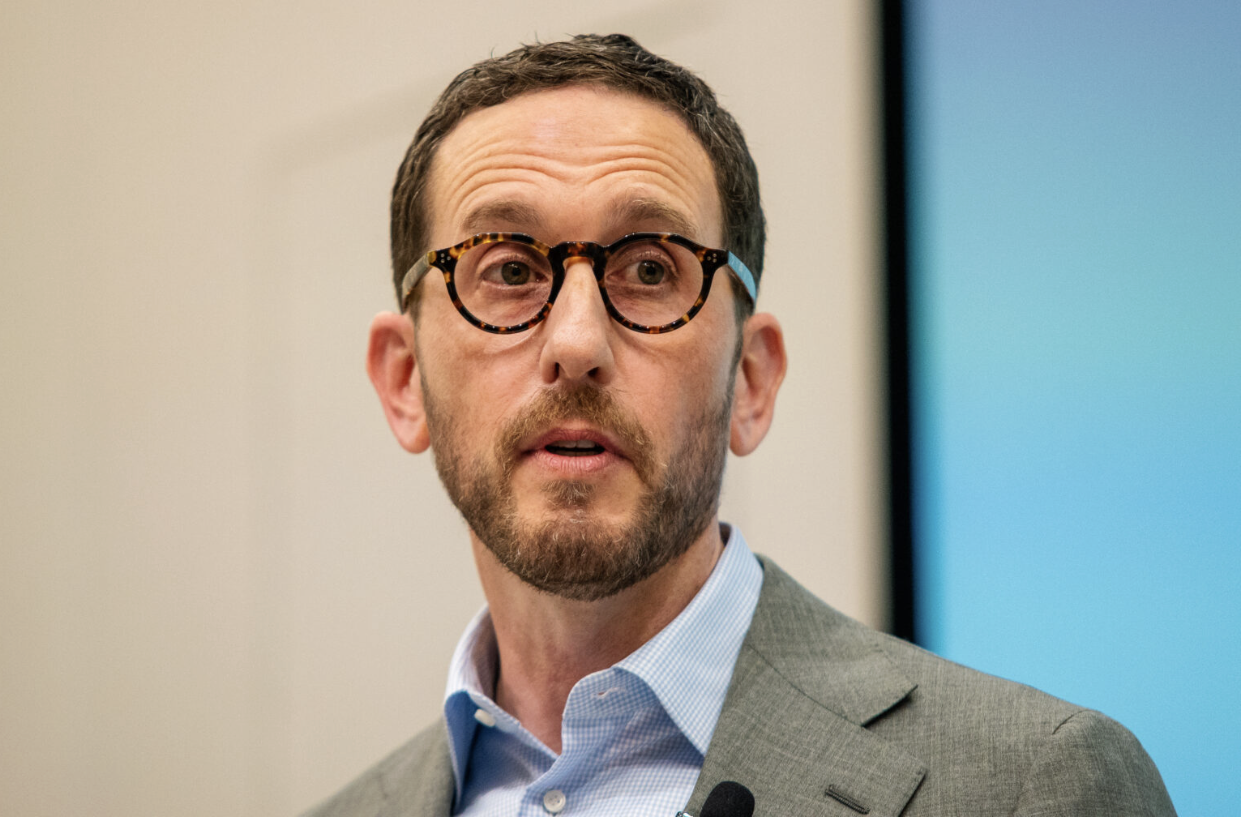
Scott Wiener may claim that he’s passed a lot of “housing legislation” in Sacramento, but he’s got painfully few actual homes to show for all his efforts.
Even from his days as a local supervisor, he was no friend of housing justice. My first dealings with him were in 2013 when he and then-Sup. Mark Farrell tried to cannibalize thousands of rent-controlled units into luxury condos. In 2016 he supported a ballot measure to criminalize homelessness on the streets. These are the types of things he was a YES on.
But when it came to poor and working-class people, he was a NIMBY NO all the way. He opposed 2018’s Prop F to guarantee legal counsel for tenants. Scott stood by his real estate friends on two statewide efforts to expand rent control by repealing Costa Hawkins. And in 2018 he opposed Prop. C, a comprehensive approach to addressing homelessness through emergency rent subsidies, housing first, and mental health and addiction support.
These aren’t the only reasons I distrust Scott. His acceptance of Israeli genocide (only recently switched after a painfully embarrassing episode of waffling in public) and his ongoing attempts to erase teaching about Palestine in our schools is not unrelated to his housing positions. His support for the dispossession of Palestinian lands has its local corollary in his acceptance of the displacement of working-class communities in his own city.
The moment I understood the racial dimension Scott’s politics was in the early 2010s when I was organizing with a transit justice coalition (made up of my then-organization CCHO, POWER, Senior & Disability Action, and Transit Riders Union). We met with Scott in his supervisor’s office, calling out the obvious racial implications of the policy of T-Line turnarounds, stopping the Third Street metro line at Mission Bay, and cutting off service to Potrero, Bayview and Visitacion Valley. Similarity, he supported the J-Church turnaround at Noe Valley, cutting off service to the Excelsior and City College. He had the classic white man’s defensiveness, claiming that the MTA decisions were just “based on core ridership numbers,” and it was irrelevant whether it was Black and Chinese residents who were left waiting at the platforms for trains that never came, or seniors stranded with their groceries, or working class students who couldn’t get to City College, while Mission Bay doctors and Noe Valley moms continued to be served. The racist overtones continue to echo in this week’s controversy over Scott’s use of racist and sexist tropes in an “ai chatbox” claiming to imitate his congressional opponent.
His pro-housing claims are as thin as his pro-transit claims. When San Francisco voters passed a surplus property ballot measure, Scott immediately transferred a city-owned property planned for homeless housing into a gated community garden for his local NIMBY constituents. And when the NIMBYs came out to fight a planned Transitional Age Youth home in the Castro, Scott hid in silence. That’s Scott Wiener: YIMBY for the wealthy, NIMBY for the poor.
Scott claims that the deregulatory approach he followed for ten years at the State Capitol has resulted in thousands of new units of housing. That’s simply not true. Let’s look at the numbers. San Francisco saw a spike in housing construction in 2017, before Scott’s first legislative win, with almost 5,000 units completed in one year—the highest since the early 60s era of public investment in housing. Since 2017, Scott has passed a raft of housing bills, starting with SB 35, and each year, less housing has gotten built. In 2024, only 1,400 units were built. On the other hand, with all of Scott’s streamlining and deregulation bills, the number of planning “approvals” shot up, with close to 6,000 units approved in 2024 alone. Today we have a backlog 50,000 “approved” units, with no financing in sight, but a growing market of speculative sales of “entitled” land. Based on the data, you could draw the conclusion that the more “housing bills” Scott passes, the less housing actually gets built.
This is not to say that there may not be some good or necessary things in Scott’s bills. But it is a lie to say they have resulted in any actual housing getting built. He’s been simply barking up the wrong tree. Or playing the oldest trick in the politician/magician’s sleeve: trying to make the marks look in the wrong direction.
All that Scott’s bills have accomplished are giveaways to land speculators and pandering to the libertarian fantasies of the tech crowd and the pockets of his donors. In 2017 and 2018 he passed a double whammy of SB35 to streamline approvals when cities didn’t meet the state-mandated housing production goals, then insidiously authored SB828 to triple those goals (with little relation to actual need), making sure that no city in the state would ever be able to achieve those goals. The result was to ensure “by-right” luxury housing approvals statewide, with no requirement to actually build the housing, and no funding for the affordable portion of the goals. In 2025 he passed SB79, a blanket upzoning affecting 3/4 of San Francisco, which raised height limits in many areas from the more affordable wood-frame construction to much more expensive concrete and steel construction, which ironically may result in slowing down housing production while jacking up land values. And just this year, he was a supporter of AB736, which would have done away with one of SF’s only direct sources of funding for affordable housing, the real estate transfer taxes on properties over $10 million dollars. Who loves $10 million properties? Scott Wiener does.
Laws don’t build housing. Investment builds housing, whether private investment dependent on the whims of Wall Street, or public investment dependent on political will and leadership. No amount of trickle-down deregulate and race-to-the-bottom laws are going to attract Wall Street capital when the capitalists don’t want to build. Building depends on other factors: increasing rents, stable construction costs, lower interest rates, which together may or may not be enough to justify the 21percent returns that the up-front mezzanine investors demand, and the 16 percent Internal Rates of Return that are the minimum to move private equity. Even when that great AI bubble finally pans out and the investors do decide to build, they are certainly not going to overbuild to the point that their returns go down.
The central thesis of the YIMBYs is that “we have not built enough housing.” Who is this “we?” If the question is “how do we build enough housing,” then the answer has to be that “we” can’t depend on the same Wall Street capitalists that got us into this mess to bail us out of it. They won’t. If “we” want to build more housing, then “we,” the public, have to finance it. Cities with sane evidence-based policies for housing — from Vienna on the “left” to Singapore on the “right” — have figured out that to have a healthy housing environment, “we the public” have to create the housing infrastructure for the 60 percent of us left out of the real estate market, and then we can be comfortable leaving the other 40 percent to private equity, which will do fine on its own.
There are real questions that need to be addressed around how we increase housing supply: new public finance mechanisms, loan guarantees, property tax issues, construction costs, and the thorniest, the single biggest driver of housing costs, income inequality. No easy questions. But rather than spending his political capital and supposed “housing leadership” addressing the real questions, Scott Wiener spent ten years wasting our time with worn out Reaganomics-era solutions. And all he has to show for it is a lot of toilet paper laws on the Senate floor, a crapload of donation checks, and a whole bunch of YIMBY click-bait.
Taking housing seriously will take vision and political will. Scott Wiener’s housing record points to neither.