
We have never witnessed a threat to democracy and basic political and human rights than the past two years of the Trump Administration. It’s terrifying, the sort of thing we couldn’t have imagined even in dystopian fiction: An authoritarian president whose troops seize Americans off the streets and deports them to torture prisons with no due process, pours billions into endless wars that kill children, alienates our allies, attempts to control what teachers can say to students, insults and attacks the news media … and gets away with it because of a disgracefully compliant Congress and Supreme Court.
George Orwell would have a hard time coming up with anything worse.
So the most important thing anyone can do right now is spend time, money, and effort to make sure that the Democratic Party—weak and problematic as is is—takes control of the House and Senate.
A time will come when we as a nation and as a society will look back on these past two years the way we now view the witch hunts of the Red Scare in the 1950s, and everyone who sided with Trump will be either in prison or treated as a social and political outcast. We can’t wait for that time to come.
We are under no illusions about the failures of the Democratic Party, which has not only buckled to Trump but has failed to put forward an agenda that addresses economic inequality and a human-rights-based foreign policy that can win. We are, however, encouraged by the victories of primary candidates who have carried that message, and they may signal the beginning of a turnaround.
In California, the Democratic Party candidates for statewide office are, with a few exceptions, a sad bunch who show no signs of leading any type of serious fight against the Trump agenda. They are allies of the Big Tech and Real Estate billionaires whose often bizarre agenda reeks of its own type of tyranny. Many will win, by default.
They reflect the pattern that has been set by Gov. Gavin Newsom, who seems to have no basic political moral compass at all, except that which points to his campaign for president. He has flip-flopped on so many issues that we can’t even begin to figure out what, if anything, he stands for.
This is an embarrassment to the nation’s largest state. We face a crisis of affordability, economic inequality, climate disaster and so much more—and hardly anyone running for statewide office has anything remotely resembling an agenda to address those problems.
But in San Francisco, there are critical races that will determine the future of the city. A small number of tech billionaires have spent the past few years pouring huge sums of money into controlling local politics, from the Democratic County Central Committee to the Mayor’s Office and the Board of Supervisors. They now want to eliminate much of the citizen oversight that has defined the city’s government for decades, consolidate power in places they can control, and undermine the ability of the voters to put checks on their frightening agenda.
Since Mayor Daniel Lurie took office, and encouraged an AI boom in an effort to help the giant corporations that own downtown office buildings to make big money again, rents have gone up by 25 percent or more. Evictions are soaring. The jails are packed with people who belong in drug treatment—but there are no treatment beds for them. Despite his promises, more people become homeless every day than the city can move into supportive or affordable housing.
Some of the supervisors who support this agenda are on the ballot essential unopposed. But in districts 8 and 10, competitive races will help determine the balance of power on the board.
The race for Congress is about far more than national office; the winner will play a huge role in local politics for several decades to come.
Our endorsements follow.
STATE RACES
Governor.
Lieutenant Governor. Controller.
Treasurer.
Attorney General.
No endorsement
If any one of these candidates told us what they would do to address economic inequality and the climate crisis, we would consider supporting them. They have failed. What a scandal the Democratic Party of California has become under Gov. Gavin Newsom.
Secretary of State
Shirley Weber
At a time when Trump is trying to destroy democracy by undermining the right to vote, Weber has been a consistent advocate for open government and voting rights. We’ll back her for another term.
Insurance Commissioner
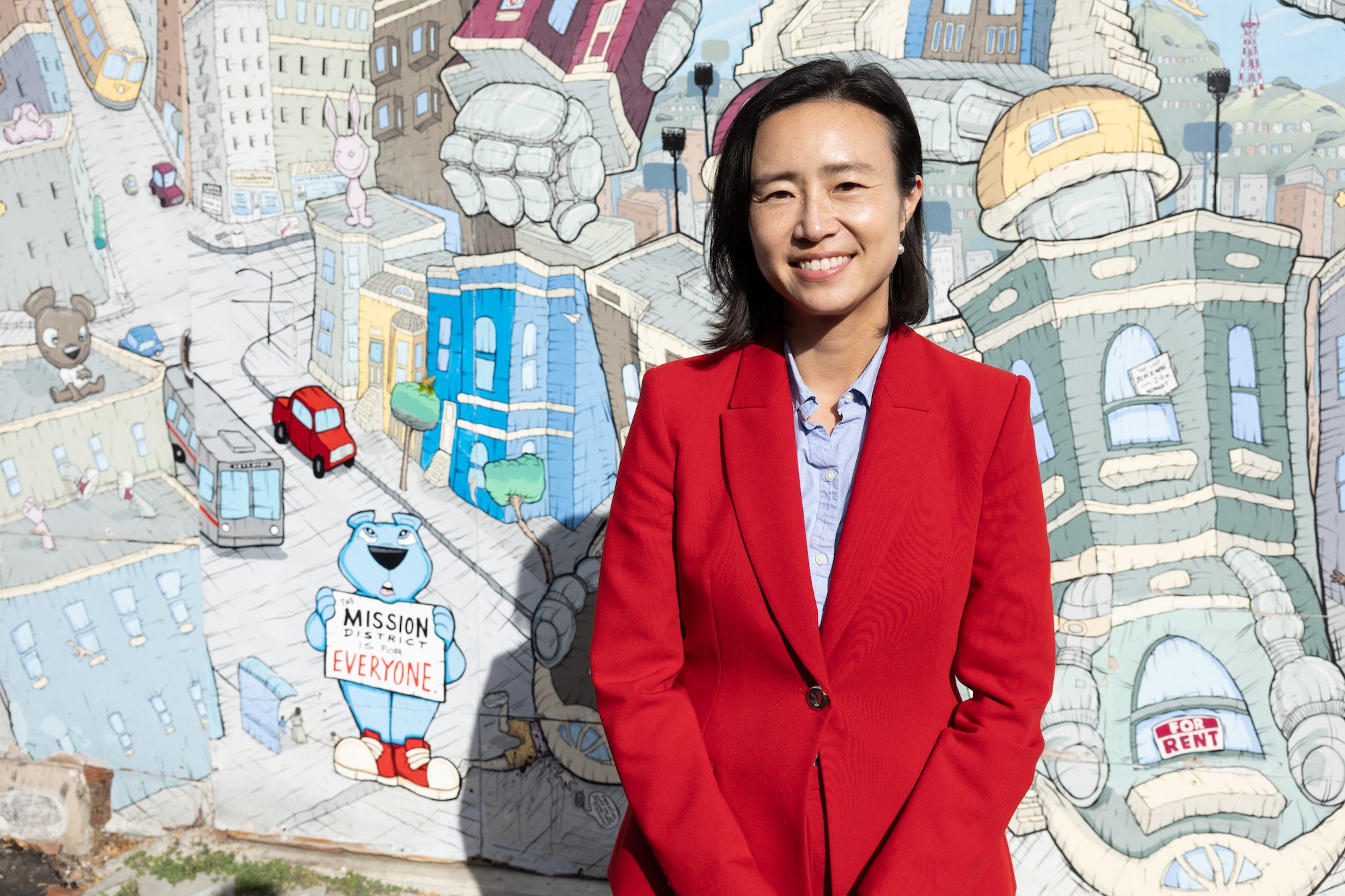
Jane Kim
The insurance market in California has lots of serious problems. None of them will be solved without better regulation. An elected insurance commissioner was supposed to promote consumer interests, but in recent years, the office has been largely on the side of the big insurers. Kim, a former SF supervisor, is talking about guaranteed natural disaster insurance, a public option for car insurance—and overall better controls over the massive, powerful industry. The next commissioner will also have to grapple with a tough issue: In an era of climate change, when is it time to recognize that some places in California are no longer habitable (and thus no longer insurable)? Vote for Kim.
Board of Equalization
Sally Lieber
The BOE used to have a lot of power (among other things, it regulated utilities like PG&E that cross city and county lines). State officials have reduced its influence, and a lot of folks are now saying it’s no longer needed. We disagree—and we’re willing to support Lieber, the current chair, who has a long record on environmental and labor issues.
Superintendent of Public Instruction
Richard Barrera
Gov. Newsom has moved to strip this job of most of its authority, but it’s still a platform for educational policy reform. Barrera, a longtime San Diego School Board member, has the support of the California Teachers Association, and we support him too.
Judges
We see no reason not to support all of these state judges for another term.
State ballot measures
Proposition 1
Affordable housing bonds
YES
Prop. 1 would allow the state to issue $11.2 billion in bonds for affordable housing. It’s a tiny, tiny fraction of what the state needs; just funding San Francisco’s state-mandated affordable housing goals would cost $19 billion. But it’s a start. Vote yes.
Proposition 2
Rainy Day Fund
YES
Prop. 2 would increase the amount of money the state has to put on reserve in good years to prevent budget disasters in bad years. Nobody seriously opposes it.
Proposition 3
YES YES YES
This one is absolutely critical. In 2012, the voters approved an income tax increase on people earning more than $371,000 a year. That money goes to education, and the tax is set to expire in 2031. Allowing that to happen would create a massive crisis for the public schools, which are already underfunded. Vote yes.
Proposition 4
Public funding of elections
YES
Prop. 4 would allow, but not require, local governments to provide public funding for candidate election campaigns. That’s a small step toward limiting the power of billionaires to control cities and counties. Vote yes.
Proposition 5
Recall practices
YES
California’s law controlling recall elections is bizarre: When a recall is on the ballot, the voters both decide whether to get rid of an official and decide who will replace them. That’s how a heavily Democratic state wound up with Republican Arnold Schwarzenegger as governor after the recall of Gray Davis. Prop. 5 would change the rules to what they currently are in San Francisco: After a recall, the position is declared vacant, and filled either by statute, appointment, or special election. Vote yes.
Proposition 37
Bonds for new home buyers
YES
Prop. 37 probably won’t make much difference in the housing market. It’s a plan to offer first-time homebuyers a state-backed second mortgage to ease the difficulty of coming up with a down payment. It would apply only to newly constructed housing, which will be way to expensive for most working families anyway, downpayment or not. But it won’t do any harm, and may help a few people.
Proposition 38
Immunology research funding
NO
Prop. 38 sounds fine: Who could be against funding research for diseases like Parkinsons? The problem is, the $8.4 billion in state bonds, which will take $500 million annually out of the state budget, must go to an organization that meets a set of difficult criteria—and the only organization currently meeting those rules is run by the person who funded Prop. 38. Note No.
Proposition 39
Voter ID
NO NO NO
This is a California GOP version of Trump’s efforts to disenfranchise voters. Vote No.
Proposition 40
Billionaire tax
YES YES YES
Economic inequality and climate change are existential crises facing humanity, and they are closely related. The level of wealth accumulated by the top 10 percent, most of it by the top 1 percent, over the past five decades (since the Reagan tax cuts) has been one of the greatest scandals in US history. Prop. 40 won’t solve the problem, but it’s a small start: It would impose a one-time five percent tax on fortunes of more than $1 billion. The No on 40 TV ads are just lies: It will not tax anyone’s retirement fund unless that person is a billionaire. We would make the tax permanent—but if California can impose a wealth tax, even a limited one, the concept may spread. That’s why the billionaires are so afraid of it. Vote Yes.
Proposition 41
Wealth tax poison pill
NO
Prop. 41 is just a poison pill that would undermine the billionaire tax. Vote no.
Proposition 42
Ban on wealth taxes
NO NO NO
Prop. 42 is a simple poison pill that would not only undermine Prop. 40 but would ban any future wealth taxes. Even the Chronicle, which opposes Prop. 40, says it’s a scam. Vote No
Proposition 43
Ban on local taxes
NO NO NO
Prop. 43 seeks to undermine a recent state Supreme Court decision that ruled local tax measures put on the ballot by citizen initiative can take effect with just 50 percent plus 1. The right wing anti-tax folks want to make that two-thirds. Vote No.
Proposition 44
Health clinic spending
NO
We get the idea of this measure, backed by United Healthcare Workers West: It would mandate that health clinics spend 90 percent of their money on direct services, not administration. But it creates such a burden in reporting that it could lead to lower levels of service. We’re opposed.
Proposition 45
Limit CEQA reviews
NO NO NO
Supporters are pushing this as a pro-housing measure, but it’s actually a sweeping attack on the California Environmental Quality Act. Even California YIMBY opposes it. Vote no.
San Francisco races
Congress
Connie Chan
It’s been 40 years since voters have had a chance to make a change in this critical seat. Speaker Emerita Nancy Pelosi, who had no record in local politics, beat the late Sup. Harry Britt (who the Chron kept calling a “homosexual socialist”) in a special election in 1987, and has controlled this safe seat ever since. Now that she’s retiring, the future of national and local politics is up for grabs.
National observers say the two candidates, Sup. Connie Chan and state Sen. Scott Wiener, are both liberal Democrats, and won’t be much different in Congress—but that’s factually false. The two have dramatically different positions on key issues: Chan supports a national moratorium on data centers. Wiener does not. Chan supports an immediate end to all military funding for Israel; Wiener does not. Chan was a big supporter of the Board of Supes resolution calling for a Gaza ceasefire; Wiener opposed it.
There’s another key issue here.
Between 1964 and 1983, this seat was occupied by Phil Burton, who was a powerhouse in Washington, and in San Francisco. Burton helped the likes of Willie Brown and Art Agnos run for and win office. He controlled the San Francisco Democratic Party, and singlehandedly gerrymandered legislative districts to keep Democrats in power in the California Legislature and Congress.
Pelosi, for all her accomplishments in Washington, had a pretty low profile in local politics. She was all about electing national Democrats and rising in leadership. There was no “Pelosi Machine” in San Francisco.
That’s going to change next year.
Both Chan and Wiener have deep roots in local politics, and the winner will have immense resources to influence local races. That’s why the tech billionaires have put up millions to attack Chan and elect Wiener. They want to control the city—and a Rep. Connie Chan would stand in their way.
Just look at the money in the independent expenditure committees. Supporters of Wiener are almost entirely Big Tech. Supporters of Chan are almost entirely labor unions.
Chan talks about taxing the rich. Wiener told us that he would never even consider an income tax on the rich to fund public transit. Chan has taken the position that allowing developers to build more luxury housing won’t bring down rents for the working class. Wiener is a leader in the YIMBY movement, and his legislation has stripped San Francisco of the ability to regulate land use. Even Lurie doesn’t like the massive Marina Safeway project, but he can’t stop it; thanks, Sen. Wiener.
This race is about as clear and as important as we can imagine. Do you want the next member of Congress, with all the money and power that position brings, to be the ally of Big Tech and Big Real Estate, or the ally of labor?
Vote for Connie Chan.
Public Defender
Mano Raju
Easy call. Raju has done an exceptional job leading one of the best public defender’s offices in the nation. He had the courage to stand up to the courts and refuse to take some felony cases when the caseload of his staff was too high for effective counsel. He has challenged District Attorney Brooke Jenkins on her pointless prosecutions. He is a leader in criminal justice reform, and we are happy to support him for another term.
Assessor Recorder
Joaquin Torres
Under Prop. 13, the role of the assessor in California is limited; the office can’t go around every year and re-evaluate property for tax purposes. But it can fight big businesses that seek tax reductions—and the Recorder’s Office can be a source of important information about property records. Torres has done a credible job, although the Recorder’s Office website, which should have a simple database of property records, is still a bit clunky and hard to use. He needs to work on making the data in his office more easily accessible.
Board of Supervisors
District Two
No endorsement
In the June primary, Lori Brooke made a valiant effort to challenge Stephen Sherrill, appointed by former Mayor London Breed, from a neighborhood perspective. Now Sherrill is in essence unopposed. He’s a Lurie call-up vote, wrong on almost every issue.
District Four
No endorsement
Talk about an embarrassing example of unchecked ambition. Alan Wong ran for Community College Board as part of a progressive slate. He was with the union, which supported him—until suddenly he wasn’t. When the mayor appointed him to the D4 seat, he immediately became one of the most conservative members of the board. The guy has no political convictions or morals. Albert Chow, who owns a hardware store in the district and was a leader in the campaign to recall former Sup. Joel Engardio, is running against Wong, but has no serious chance.
District Six
No endorsement
Incumbent Matt Dorsey, a former media person for the SFPD, has become one of the most conservative, pro-cop members of the board. he has pushed hard, and won, legislation that undermines the city’s longtime “housing first” policy to mandate that people in some supportive housing avoid drugs, and can be evicted if they fail to maintain sobriety. He is a close ally of Lurie, and has no serious opposition.
District Eight
1. Michel Nguyen
2. Gary McCoy
Nguyen is the only progressive in the race, supported by former state Assemblymember Tom Ammiano, former Sups. Dean Preston, Sandra Lee Fewer, John Avalos, and Gordon Mar, as well as the Milk Club and SF Rising Action Fund. He’s the only candidate who has made social housing, not market-rate development, a priority, and he supports Prop. I.
McCoy, former district director for Pelosi, is the choice of SF YIMBY, and would be at best a centrist on the board, in the mold of outgoing Sup. Rafael Mandelman. We do not agree with his priorities or positions on many issues, but he is a strong advocate for public health.
The front-runner for much of the races was Manny Yekutiel, a close ally of Mayor Daniel Lurie, who endorsed him. So did the Democratic Party, which ignored its own policies to support a candidate who has been accused of sexual assault. (Lurie says the Yekutiel told him the charge is untrue, and that’s good enough for him.) He would have been a call-up vote for the mayor at a time when the board badly needs at least some semblance of independence.
When another two men came forward with allegations of sexual assault, Yekutiel dropped out. But his name is still on the ballot.
We prefer Nguyen. We can live with McCoy.
Supervisor, District 10
DJ Brookter
JR Eppler
Shamann Walton has been an excellent D10 supervisor, one of the best board members we have worked with over the years. He’s been a strong advocate for his community, and an independent voice on the board, willing to stand up to the mayor (any mayor) and always willing to ask tough questions of developers and private interests. His shoes are big to fill.
The front-runner in this race is Theo Ellington, who is the candidate of Big Tech: crypto billionaire Chris Larsen put $500,000 into an IE supporting him. Ellington has tried to distance himself from Larsen, saying he would support a ban on data centers. But there’s a reason the mayor’s billionaire allies want him in office. Two other solid candidates are in the race: JR Eppler, a lawyer and community activist in Potrero Hill, and Dion Brookter, a community developer who has the endorsement of Walton.
Eppler told us he supported Lurie’s upzoning “to comply with state law,” but he opposes Flock cameras and supports the billionaire tax and Prop. I.
Brookter also opposes Flock cameras and the mayor’s upzoning plan, is Yes on 40 and Yes on I, and he has such broad progressive support that we are happy to endorse him.
Pick an order; both are great choices.
Community College Board
Leah Lacroix
Jeremy Lee
Bunny McFadden
City College has been in crisis mode for years, since a rogue accreditation agency tried to shut it down. A progressive slate backed by the teachers’
union is running to restore some credibility to the critical institution. We support all of them.
Community College Board
Single seat
No endorsement
Ruth Ferguson is the unopposed incumbent in this race, which exists because the mayor appointed her to the board, and she now has to face the voters. She is a leader in SF YIMBY and clearly is using this slot as a springboard to a run for supervisor. We don’t support her.
School Board
Virginia Cheung
Reina Tello
Ryan Hazelton
The teachers’ strike sent a message to the SF Unified School District:
Investing in educators in an investment in education. Now the union has a slate of candidates who can expand that vision. We support them all.
Regional Proposition
Proposition RTM
YES
Prop. RTM is a regional sales tax hike that is probably the only way to save BART from near extinction. We are not fans of sales taxes, and would have much preferred a regional income tax. State Sen. Scott Wiener, who sponsored RTM, told us he wouldn’t even consider that. So RTM it’s regressive and unfair, but we really have no choice. The measure needs to pass. Vote Yes.
San Francisco propositions
Proposition A
Charter changes
NO NO NO
Prop. A is part of Lurie’s move, supported by $8 million in billionaire tech money, to increase the power of the Mayor’s Office and eliminate community oversight of City Hall. This one would allow the supes to overturn existing voter-approved legislation; among other things, it would let the board gut the independence of the Sunshine Ordinance Task Force and eliminate the Our City Our Home oversight board. Vote No.
Proposition B
Public Bank
YES yes yes
Activists, led by Sup. Jackie Fielder and former Sup. Dean Preston, have been working for 10 years to get to the point where the voters can decide whether to authorize the city to start moving toward a public bank. Prop. B doesn’t create the bank, and it doesn’t set aside any funding for it; that’s a process for later. What it does is create the outlines of a mechanism for the city to do what no other municipality in the country has done: Establish a city-owned financial institution that could, among other things, hold the $2 billion or so in working money that the city now puts in banks like Wells Fargo or Bank of America, and use that cash to finance affordable housing. We are a long way from open the door of a depository institution, and all the scary talk about hundreds of millions in costs is just that: Scare tactics. A public bank would require considerable further work, structure, and oversight. But it’s an excellent idea, and Prop. B moves it forward. Vote yes.
Proposition C
Affordable Housing Trust Fund
YES
Let us be under no illusions: The mayor and his allies put this on the ballot as an effort to undermine Prop. I, which mandates that money the voters authorized for affordable housing actually goes for affordable housing. But it’s still a good measure: It would use tax-increment financing to increase the amount of city money that is earmarked for affordable housing, reaching as much as $125 million a year. We don’t support the deal that some affordable housing groups made to abandon Prop. I in exchange for the mayor’s support of Prop. C. We want both to pass.
Proposition D
Initiative signature increases
NO NO NO
Prop. D is another in a series of mayoral and billionaire power grabs, and it’s the worst of the package: It would quadruple the number of signatures required to put an initiative on the ballot and eliminate the ability of four supes to place a measure on the ballot with their signatures. That would almost guarantee that only rich special interests will be able to sponsor ballot measures. Mayor Lurie, who is supporting Prop. D, used the lower number of signatures to put his other measures on the ballot. Vote No.
Proposition E
Eliminate contracting oversight
NO
Again, in the name of “fighting corruption,” Lurie and the billionaires are proposing a measure that would encourage corruption. Prop. E would eliminate Board of Supes and community oversight of tens of millions in city contracts. Vote No.
Proposition F
Expand mayoral power
NO
Prop. F would allow the mayor to fire commissioners at will, undermining the entire idea of community oversight and a commission structure. Mayor London Breed was unable to fire an excellent Police Commission member who didn’t always do her will. Prop. F would change that, and mandate that all mayoral appointees do exactly what the mayor says at all times. It’s another power grab. Vote No.
Proposition G
Great Highway compromise
YES
We are going out on a limb here, but we take the same position we took the last time this was on the ballot: Closing the Great Highway to cars is an excellent idea—as long as the city provides adequate North-South transit to replace it.
That hasn’t happened.
We love parks, and Sunset Dunes is just fine. But a lot of working-class people relied on that road to get to work, shopping, child care, and medical appointments. There is no other North-South route across Golden Gate Park except 19th Avenue, which is so choked with traffic these days that a woman on her way to the hospital had to give birth in her car, in gridlock.
The original deal worked fine: Open the road to cars during the week, and close it on weekends. At some point, the highway will have to close because of sea-level rise anyway, and by then the city should be able to create a viable North-South transit system, perhaps with a dedicated bus lane on 19th Avenue through the Park, and we will be happy to see a park—as long as it lasts.
Proposition H
Parcel tax to fund Muni
YES
This one is easy: The city desperately needs money to keep Muni alive and functioning, and although we prefer income taxes to property taxes, this proposal is relatively fair. It taxes large commercial parcels at a higher level than small residential buildings, and most owners will pay only a small amount every year. We wish the city would ban landlords from passing through these taxes to tenants, but advocates managed to set a cap on the passthroughs. Vote Yes
Proposition I
Affordable housing guarantee
YES YES YES
Prop. I should never be on the ballot. It wouldn’t be necessary if former Mayor London Breed, in a fit of vindictiveness, refused to spend the money voters approved for social housing in 2020. Instead, she took more than $100 million a year and diverted it to other priorities, including the cops. She did that because that 2020 measure was backed by Sup. Dean Preston, who had defeated Breed’s hand-picked candidate in D5. Lurie has continued to defy the will of the voters, and argues that he needs that money for public safety.
The money, from a tax on high-end property sales (mostly paid by big commercial speculators), would not exist if the voters hadn’t believed it was going for affordable housing.
Prop. I mandates that the tax money go where it was always supposed to go. Vote yes.
Proposition J
Foreclosure exemption and property taxes
Yes
Prop. J was supposed to be a way to allow the mayor and its sponsor, Sup. Bilal Mahmood, to undermine Prop. I by cutting the tax rate on high-end properties. The utterly flawed theory was that taxes on properties sold for more than $10 million might discourage new housing development. The seller pays the tax anyway, so no developer wanting to buy property for housing would be discouraged by the tax.
Still, to make up some of that revenue, Mahmood suggesting eliminating the current tax exemption for buildings in foreclosure. Nothing wrong with that, now that Prop. I is on the ballot too and his plan to cut taxes on the very rich has gone nowhere.
Full disclosure: Tim Redmond’s independent adult daughter works on the Connie Chan for Congress campaign.